 Theorie B
Short answer
You must not use full beam when meeting another road user. A cyclist is a road user too, so switch to dipped headlights.
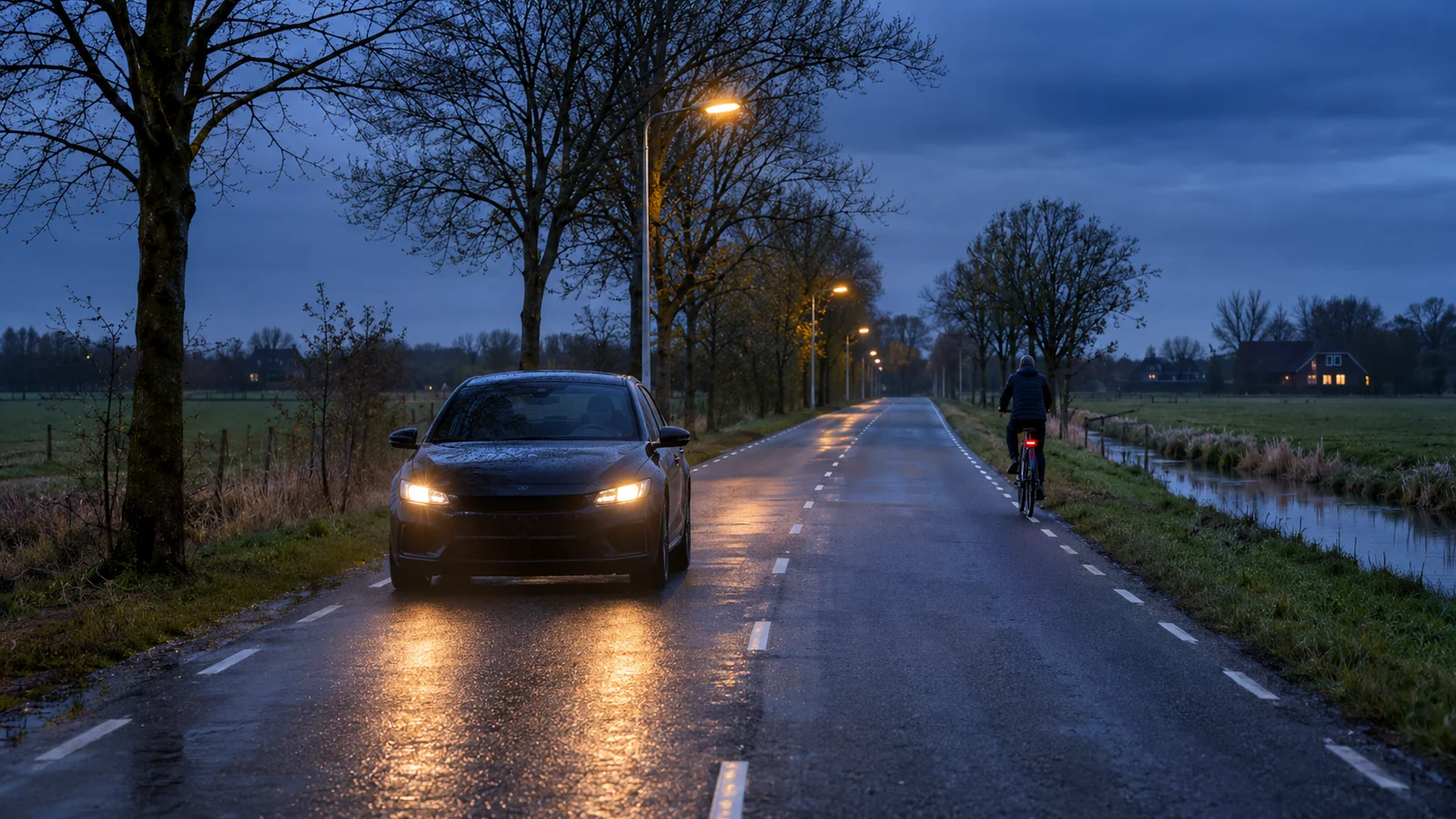
You're driving in the dark on full beam. Up ahead, a cyclist is coming towards you. There is no car behind them and you want to keep a clear view. Can you leave full beam on?
The rule applies to cyclists too
Oncoming traffic often makes people think of cars. You see two headlights and know you need to dip yours. But the rule concerns meeting another road user, rather than only an oncoming car.
Whether the other person is driving a car or riding a bike makes no difference here. When you meet the cyclist, you must not continue using full beam.
The fact that full beam gives you a better view does not create an exception.
An example on a dark road
You're driving along a dark road in the evening. Full beam lets you see the course of the road clearly. Then you spot a cyclist approaching from the opposite direction.
You switch to dipped headlights. Your lights stay on, but you turn off full beam for the approaching road user.
Switching off all your front lights is not the answer. You need to change from full beam to dipped headlights. You do not have to wait until you are certain your lights are bothering the cyclist.
The misconception: I only need to dip for cars
This mistake comes from automatically treating oncoming traffic as meaning cars. Read the rule more broadly: it concerns another road user coming towards you.
Make a conscious effort to look for cyclists in the dark. They may be less noticeable than a car with two headlights, but they still count under this rule.
It is not a question of whose lights are brighter either. The cyclist's less powerful light does not give you a reason to keep full beam on.
Try it / Practice question
You are driving at night with your main beam on. A cyclist is approaching from the opposite direction. What do you do with your lights?
You must not use main beam when meeting another road user.
RVV 1990, art. 32 lid 2 onder b